The Rules That Make Magic Happen: Hard vs. Soft Systems
Let’s talk about magic. Not the “pulling a rabbit out of a hat” kind, but the kind that lets fictional characters level cities, curse their enemies, or accidentally turn their roommate into a ferret.
For writers, one of the most exhilarating (and terrifying) blank pages faced is designing a magic system. How does it work? What are the consequences? Does it require a PhD in fantasy physics, or does it just require a really dramatic hand gesture and a dream?
In the fantasy community, we generally divide magic into 2 camps: Hard Magic and Soft Magic. (Terms coined by Brandon Sanderson.) But before you start choosing sides like it’s a high school pep rally, let’s break down what these terms actually mean and how to use them.
Hard Magic: The Meticulous Magic of Mathematicians
Hard magic is the science of the fantasy world. It has strict, unbreakable laws, clear costs, and predefined limitations. The reader understands exactly what a magic user can and cannot do. If a character wins a fight using hard magic, it’s not because they believed in themselves really hard; it’s because they outsmarted their opponent using the established rules of the game.
The Ultimate Example: The Law of Equivalent Exchange in Fullmetal Alchemist. To gain something, something of equal value must be lost. It’s essentially mystical chemistry. You want to fix a broken radio? You need the exact raw materials to do it. You want to bring someone back from the dead? Well... maybe don’t do that. Ask the Elric brothers how that worked out.
If you want a brilliant breakdown of how to build these kinds of limitations, check out this fantastic video by Hello Future Me.
Soft Magic: The Magnificent Magic of Mythologists
Soft magic, on the other hand, is all about vibe, mystery, and wonder. The rules are hidden, vague, or sometimes nonexistent. We don’t know how the magic works; we just know it’s powerful, ancient, and deeply unpredictable.
The Pioneers: J.R.R. Tolkien’s otherworldly wizards. Gandalf doesn't have a mana bar. He doesn't say, "Ah, I can't cast Light because I'm out of spell slots." He just shines a light because he is an ancient, almost angelic being.
The Grim & Gritty: George R.R. Martin’s A Song of Ice and Fire. Magic here is rare, dangerous, and usually involves blood, shadows, or dragons. There is no textbook for it. We don’t know why dragons won’t cross ice walls or why some people come back from the dead (or don’t).
The Modern Epic Romance: Sarah J. Maas’s ACOTAR series. The power of the Fae High Lords is massive and dazzling, but it operates heavily on emotional stakes and rule-of-cool rather than rigid formulas. (A lot of romantasy worlds operate in this zone, and Maas does an excellent job of making magical outcomes feel earned.)
The Sci-Fi Slip: Stranger Things. Technically, sci-fi, but with all the D&D references, are we really surprised? Eleven's powers started relatively grounded (nosebleeds and telekinesis), but as the seasons rolled on, we hit some confusing power creep. When soft magic lacks an anchor, the powers tend to expand simply to match whatever the new season's villain is doing.
For a great look at how to pull off soft magic without letting it ruin your plot stakes, throw on this video (yes, I’m a big fan of this particular creator and you should be too, just saying).
The Sliding Scale of Arcane Nonsense
Here is the secret most writing manuals won't tell you: hard and soft magic aren't 2 separate boxes. They exist on a sliding scale.
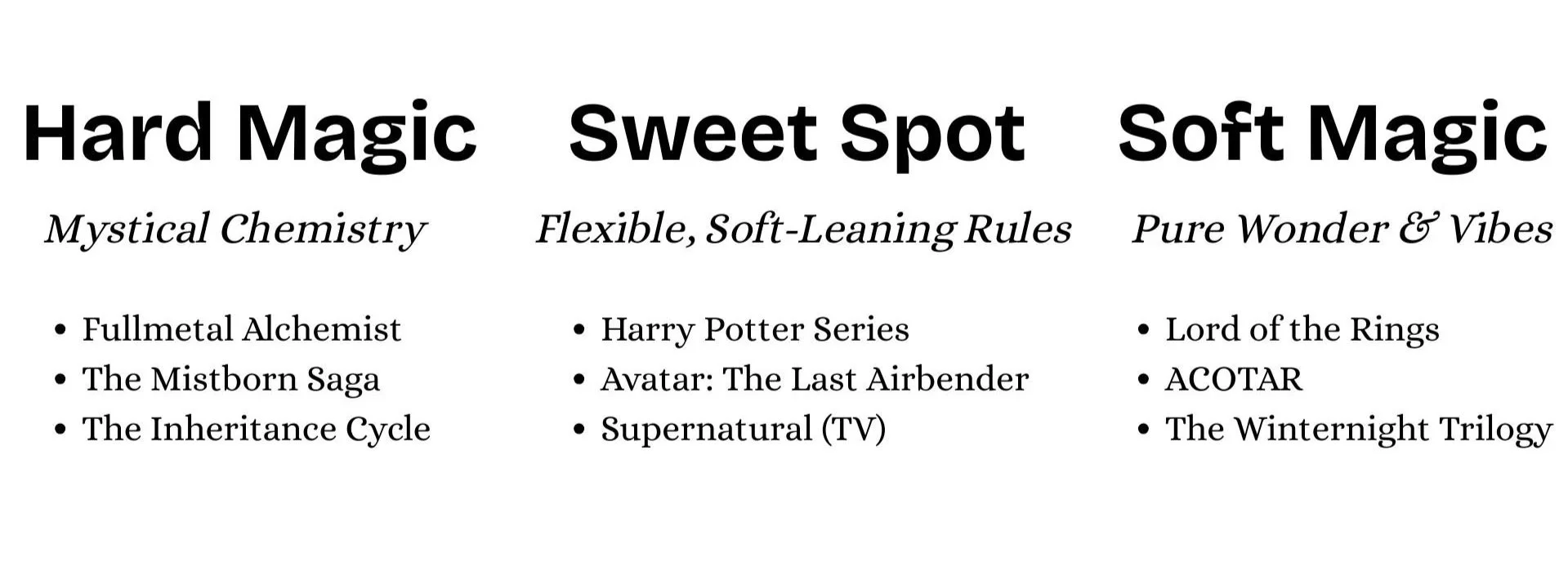
A few examples of how popular IPs fit into hard magic and soft magic systems.
You can sit comfortably right in the middle. Many soft magic systems actually have rules, but often less prescriptive and more flexible. You might know that magic requires a sacrifice, or that it can only be done at night, without knowing the exact “atomic weight” of the spell. You might know it requires a sprig of blackthorn, but not the quantity or quality.
The incredibly kind flexibility a scale offers can give readers just enough structure to feel safe, while keeping the ceiling of possibility completely open.
How Do Writers & Creators Choose a Path?
While we could sit down with endless reasons to choose one or the other, for me, it comes down to one big (yet simple) question: How does this impact the characters?
Soft magic often works really well in stories like fairy tales and fables where magic is meant to be unknowable. It often operates on morality (reward the good, punish the bad) or shows the audience what makes a character worthy of being remembered because of how they faced the impossible odds and infathomable wonder.
Hard magic works well when a writer wants to ground the reality, or make a world “believable.” (Reminder: Believable doesn’t equal true or factual. A talking cat in a striped hat with reality-warping powers isn’t believable in Twilight, but is it believable in A Cat in the Hat.) If, in a writer’s world, the streetlights run on magic, the story needs to know where that magic comes from, what would cause it to run out, and who's in charge of making sure that doesn’t happen.
Let’s look at this contrast at a character level: Gandalf can do a number of fantastical things without explained rules in LOTR because wizards are meant to evoke a certain otherworldly wonder. Put Gandalf in Eragon, and the reader has to wonder if he’s saying the right words every time, or where he’s getting the energy to do all these big-scale things.
With a hard magic system, the magic performed often gets tied much more deeply to character traits and decisions. In Avatar: The Last Airbender, a softer system, you can have a hot-headed waterbender because magic is tied to ethnicity/nation. No one is born with earthbending because they’re stubborn or patient. Some benders are just born more powerful. Training matters, but someone with training and talent will always overcome a bender with less talent. In Josephine Angelini’s Worldwalker series, witches can create only as much magic as their bodies can fuel—and they need to refuel with salt, food, and other stimuli. This immediately introduces an interesting problem and a character trait: a prepared witch is much more capable than an unprepared witch. (Now picture the ADHD witch that can never remember to refill her salt pouch, so her mechanic has made it his weekly to-do.)
Hard magic systems (or middle, less-soft systems) can be a lot of fun if you enjoy very detailed world creation—and if you prefer magic to feel more like a skill than a mystery.
Why I Choose Soft for the More Flexibility (& More Wonder)
If you look at my own work, I’ll let you in on a little secret: I heavily prefer to work in the middle zone.
Now, is that NOT simply because it’s easier than spending 3 months (nay, years) drafting a fictional periodic table of elements just so my protagonist can throw a fireball? (But, yes, that’s absolutely a reason). I am a writer, not a mathematician.
But the big reason I stay in the soft zone is because of the wonder. Hard magic systems are brilliant—the clockwork engines that can drive incredible plots. But soft magic systems are the myths. They keep the world feeling vast, ancient, and beautifully unpredictable. I want my readers to feel a tiny shiver of the unknown when the magic starts to hum, rather than reaching for a calculator.
Where do you fall on the arcane spectrum? Do you want to know the exact mathematical cost of a spell, or do you just want the lights to flicker and the shadows to start talking?
