Let’s lose our heads for a moment, shall we?
Every writer loves a good silhouette. There’s something deeply satisfying about crafting a villain whose mere outline strikes terror into the hearts of your characters. But if you want to take “striking silhouette” to its absolute logical extreme, you take away the head entirely.
Enter the Headless Horseman. *lightning flashes* *evil cackling*
While modern pop culture usually points to a sleepy little valley in New York as the birthplace of this decapitated terror, the true origin story takes us across the Atlantic, deep into the foggy, atmospheric trenches of Irish folklore. Grab your silver coins (trust me, you’ll need them), and let’s talk about the original midnight rider: the Dullahan.
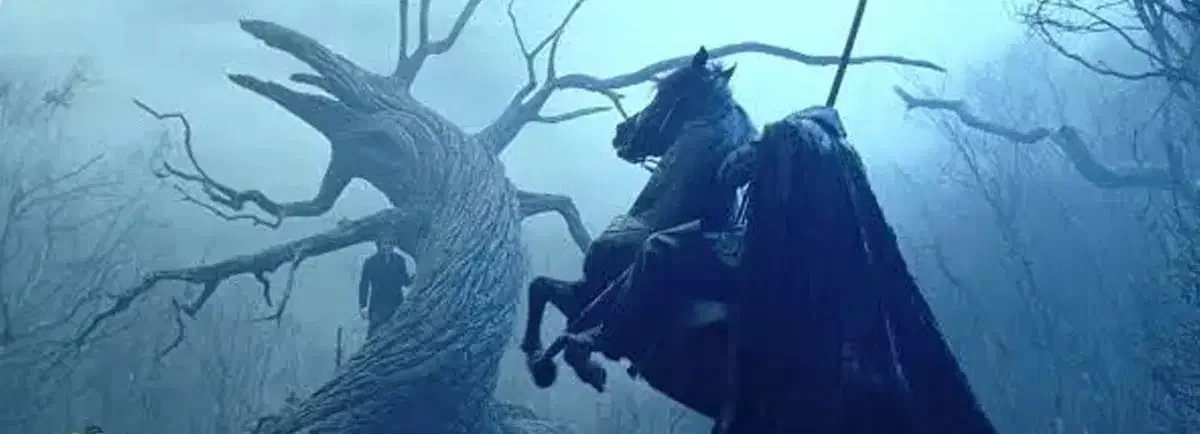
Sleepy Hollow (1999)
That tree is even more terrifying than the undead Hessian. Trust me.
The O.G. No-Head Rider: Irish Lore
Long before Washington Irving picked up a pen, Irish storytellers were whispering about the Dubhadhchan (or dúlachán, pronounced roughly doo-lah-han), which translates to “dark man.”
The Dullahan isn't just a guy who had a bad encounter with a guillotine; he is a demonic fairy—an unseelie creature of the absolute highest order. He rides a midnight-black horse, holds his own glowing, decaying head aloft like a macabre lantern to see across vast distances, and uses a whip made out of a human spine. (Talk about an aesthetic).
Also, surprisingly, he does have a head. It’s just not attached to his shoulders. To the people who joke about “forgetting their own head if it wasn’t attached,” well… Now you have no excuse. If monsters can do it, so can you.
The Dullahan Rules: Unlike your average ghost, you can’t bar your door against a Dullahan. Locks click open, and gates burst apart when he approaches. He only stops riding for one reason: to call out a mortal's name. The moment he speaks it, that person's soul is instantly ripped away.
The Quirky Weakness: If you’re writing a protagonist facing down a Dullahan, give them some spare change or a wedding band. For reasons known only to ancient mythologists, these terrifying harbingers of death are absolutely petrified of gold. Even a tiny gold pin will send them fleeing into the night.
The Sleepy Hollow Evolution: from Myth to Pop Culture
As folklore traveled with immigrants across the ocean, the Irish Dullahan merged with German tales of headless hunters to create America’s favorite literary ghost: The Headless Horseman of Sleepy Hollow.
Writers have been iterating on this headless icon for over a century, and each adaptation brings a slightly different flavour to the table. Here’s a quick look at the syllabus of headless history:
The First Adaptation & The Disney Classic (1949): Washington Irving’s 1820 short story got its most iconic early treatment in Disney’s The Adventures of Ichabod and Mr. Toad. It’s a masterclass in pacing; it starts with playful, teasing humour and ends with one of the most genuinely terrifying, atmospheric chase scenes in animation history. That flaming pumpkin throw? Iconic.
The Gothic Noir Film (1999): Tim Burton’s Sleepy Hollow leaned heavily into the dark academia, moody, fog-machine aesthetic. Here, the horseman (played with delightful ferocity by Christopher Walken) is a Hessian mercenary under the control of a vengeful witch. It traded the ambiguity of the original story for a full-on supernatural murder mystery.
The Campy/Brilliant TV Show (2013): Now, if you want a masterclass in bold, utterly unhinged adaptation choices, look no further than the Sleepy Hollow TV series. It took Ichabod Crane, put him in a time-loop resurrection plot, made the horseman one of the actual Four Horsemen of the Apocalypse, and set it in modern-day New York.
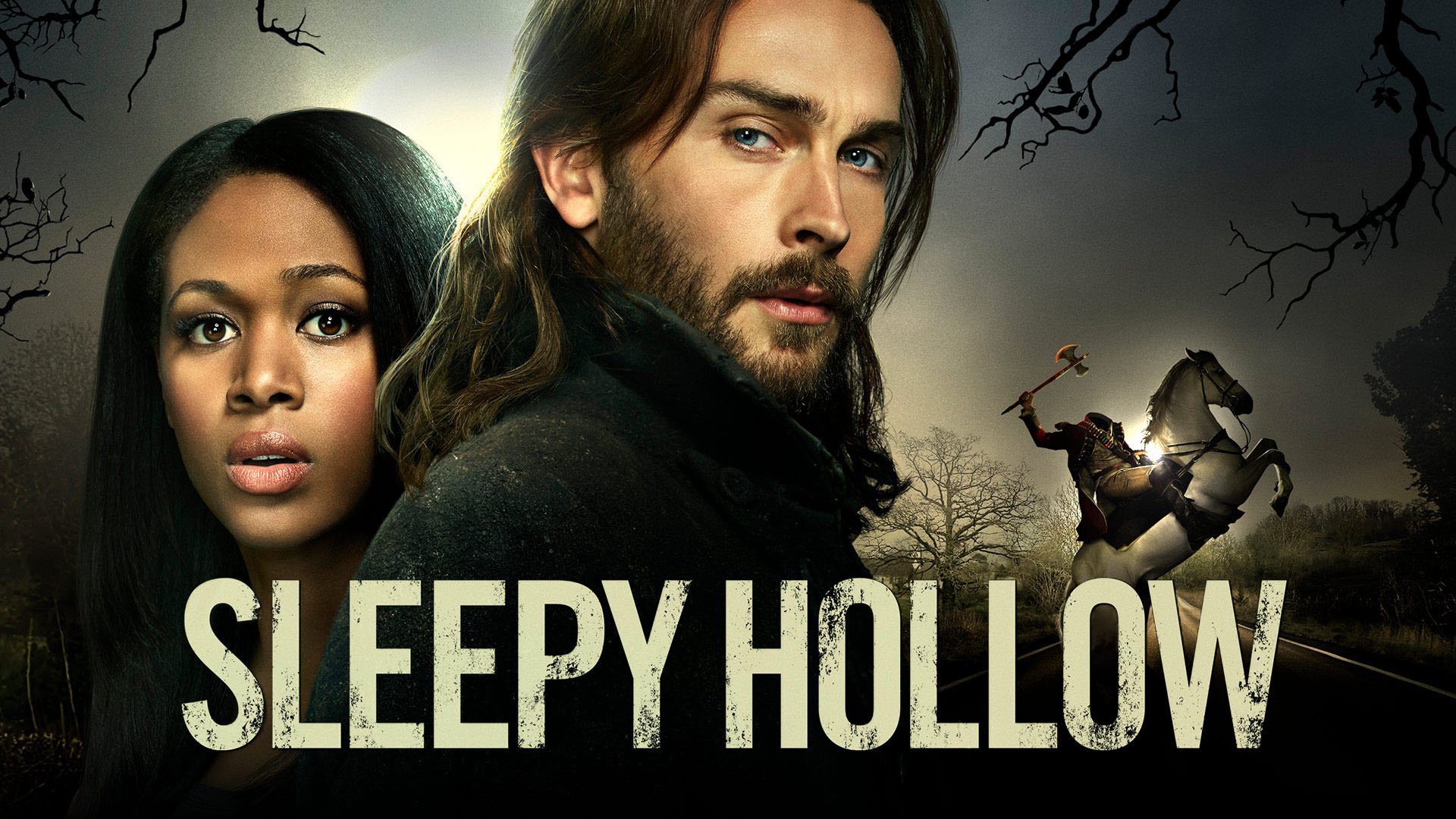
Sleepy Hollow (2013)
This was the kind of gloriously dramatic, monster-of-the-week television that glued me to the screen.
(And can we talk about the Bones crossover episode? Mixing forensic science with an ancient apocalyptic curse is the exact kind of shameless, chaotic storytelling I live for).
Why We Love a Headless Horror
So, why does this character keep rising from the grave?
Because it’s the ultimate subversion of human connection. We look at faces to read intent. We look at eyes to see emotion. When a character looks at a Dullahan or a Headless Horseman, they are staring into a void of pure, unreadable malice. It forces your characters—and readers—to rely on pure instinctual terror.
The absolute joy of being a storyteller is that you get to look at centuries of this terrifying tradition and say, “Okay, but what if I twist it like this?”
That’s exactly what I did in my own book, How to Seal a Curse (And Other Ways to Ruin Your Reputation). I couldn’t resist bringing a Dullahan into the mix, but I decided to mash up my favourite elements of the lore. In my version, the Dullahan is treated as a terrifying, ancient force of nature—very much rooted in that primal, unstoppable Irish fairy mythos. However, I layered in a dark, puppet-master twist reminiscent of the 1999 Sleepy Hollow.
My Dullahan is actually a living curse being weaponized and controlled by some nefarious villains. No spoilers, but let's just say it creates a massive headache for my characters when an unstoppable hunter is being directed by a malicious magic-user.
Whether you’re writing an ancient Irish horror story with spine-whips or a modern supernatural thriller, the headless rider is proof that a striking, terrifying concept never truly goes out of style. It just gets a new coat of paint—and maybe a few new rules.
If you were writing a headless rider into your universe, what would be their motivation? Are they a mindless force of nature, a cursed spirit seeking revenge, or an ancient fairy just doing their cosmic job?
